Class 7 Social Science Chapter 3: Empires and Kingdoms: 6th to 10th Centuries NCERT Solutions
All 24 questions with collapsible Solution and Expert Solution. Tap a button to reveal the working.
In-Text Activities: Let's Explore, Think About It & Don't Miss Out
Q 3.1
Let's Explore. Do you recall where the capital of the earlier Maurya and Gupta empires was located? How do you think this shift may have shaped the sub-continent's politics in the years to come?
Concept used. A capital city is the seat of a ruler's court, treasury and army. When a capital sits at the centre of a river system with good farmland around it, one dynasty can hold a very large, unified empire from that single point. When power moves away from that centre, unified control becomes harder to sustain.
Locate it
Pataliputra stood where the Ganga, Son and Gandak rivers meet, roughly where modern Patna stands today. This confluence gave it fertile land, easy river transport and natural water defences on three sides.
Recall the location: both the Maurya empire (from Chandragupta Maurya, 4th century BCE) and the Gupta empire (320-550 CE) ruled from Pataliputra, on the Ganga near present-day Patna in Bihar.
Note what changed in this chapter: Harshavardhana, the major 7th-century ruler of north India, ruled instead from Kannauj, further west and upstream on the Ganga-Yamuna doab.
Work out the political effect: Kannauj lay at the meeting point of trade routes from Punjab, the Ganga plains and central India, so whoever held it could watch three directions at once. This is exactly why the Palas, the Gurjara-Pratiharas and the Rashtrakutas fought over it for two centuries in the Tripartite Struggle described later in this chapter.
Connect this to political fragmentation: because the political centre of gravity had shifted to a contested, exposed city rather than a naturally defended riverine capital like Pataliputra, no single dynasty after the Guptas could hold north India as one unbroken empire for very long.
The Maurya and Gupta capital was Pataliputra (near modern Patna). The later shift of the political centre to Kannauj, a more exposed and more fought-over city, is one reason north India broke into competing regional kingdoms instead of one lasting empire after the Guptas.
RM
Ritika Menon
M.A. History, Jawaharlal Nehru University
Verified Expert
Structural observation. I like to compare capitals the way you would compare two houses: one on a quiet, well-protected street, and one on a busy crossroads that everybody wants to control.
Pataliputra sat inside a river-junction fortress-like site. It was hard to attack and easy to supply, which is part of why the Mauryas and Guptas could hold enormous territories from it for so long.
Kannauj, by contrast, was a crossroads city: valuable precisely because every regional power needed it, but for that same reason impossible for any one power to keep securely.
Read forward from this chapter: this pattern (a contested, high-value city changing hands again and again) recurs at Kannauj into the next chapter too, and later still under the Delhi Sultanate. Political geography, not just the personal ability of a king, decided how long an empire could last.
Why this matters. It shows historians that shifts in a capital's location are never accidental. They usually reveal a change in what a ruling power depended on most, whether that is farmland, river trade or control of a strategic crossing.
Pataliputra (near Patna) was the shared Maurya-Gupta capital. Kannauj's later prominence as a contested crossroads, not a protected heartland, made lasting single-power control of north India far harder after the Guptas.
Q 3.2
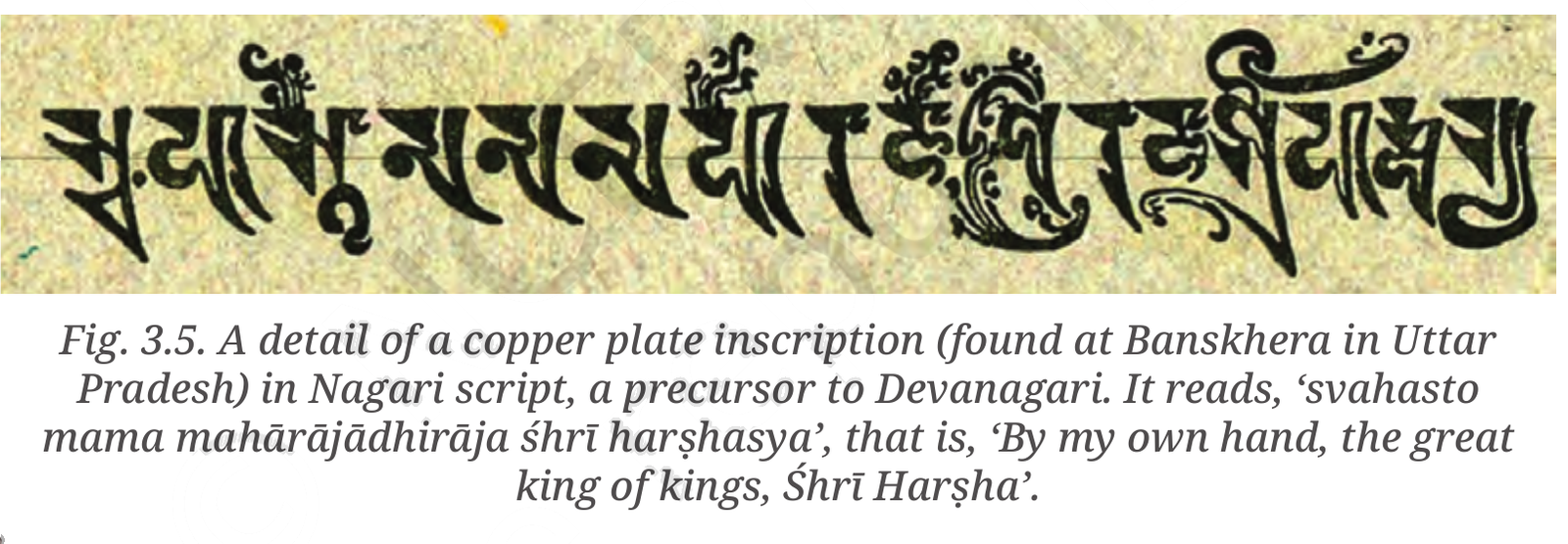
Let's Explore. If you know the Devanagari script, with the help of your teacher try to identify some of the letters in Harsha's signature. Fig. 3.5, NCERT Exploring Society: India and Beyond Class 7 Part 2, Chapter 3.
Concept used. The Nagari script used in Harsha's 7th-century copper-plate signature is a direct ancestor of the modern Devanagari script used to write Hindi and Sanskrit today. Letters in Nagari are recognisably close to their modern forms, though the shapes are more flowing and cursive because they were engraved by hand onto metal.
Recall
This inscription was found on a copper plate at Banskhera in Uttar Pradesh. The chapter tells us it reads `svahasto mama maharajadhiraja shri harshasya', meaning `By my own hand, the great king of kings, Shri Harsha'.
Start from the known transliteration given in the chapter: svahasto mama maharajadhiraja shri harshasya. This is your key: match each spoken syllable to a cluster of strokes in the image, moving left to right.
Look for repeated shapes. The syllable ma (in mama and maharajadhiraja) recurs three times in the inscription; once you find one clear ma, you can spot the others by their matching loop-and-stem shape.
Look for the compound consonant cluster in harshasya, which combines r with sha; conjunct letters like this look denser and taller than single consonants, which helps you locate them in the line.
With your teacher, read the line as a continuous flow rather than letter by letter first; then go back and isolate individual aksharas (syllabic letters) once the overall rhythm is familiar.
Working from the given transliteration (svahasto mama maharajadhiraja shri harshasya), a student who knows Devanagari can pick out repeated syllables such as ma and the conjunct rsha in Harsha's own signature, since Nagari letterforms are direct ancestors of today's Devanagari.
DR
Devansh Rao
Ph.D Ancient Indian History, Banaras Hindu University
Verified Expert
Picture-first. I always tell students to treat an inscription like a piece of handwriting from a relative, not a printed textbook line: it has personal flourishes.
Notice that this is a royal autograph (svahasto, `by my own hand'), not a scribe's formal copy, so the strokes are more personal and slightly less regular than a typeset inscription elsewhere in the chapter.
Anchor your reading on the honorific string maharajadhiraja (`great king of kings'), a title that appears again and again in inscriptions of this period, so its letterforms are worth learning once and reusing.
Compare this signature with the coin legend in Fig. 3.4 elsewhere in the chapter, both are from Harsha's own reign, and cross-checking one script sample against another is exactly how epigraphists build confidence in a reading.
Why this matters. Learning to read a 7th-century royal signature connects a student directly to a real historical person, not just a name in a textbook, and shows how today's Devanagari has a fourteen-century-old paper trail.
Using the chapter's own transliteration as a guide, a Devanagari-literate student can trace syllables such as ma and the conjunct harsha directly in Harsha's handwritten signature on the Banskhera copper plate.
Q 3.3
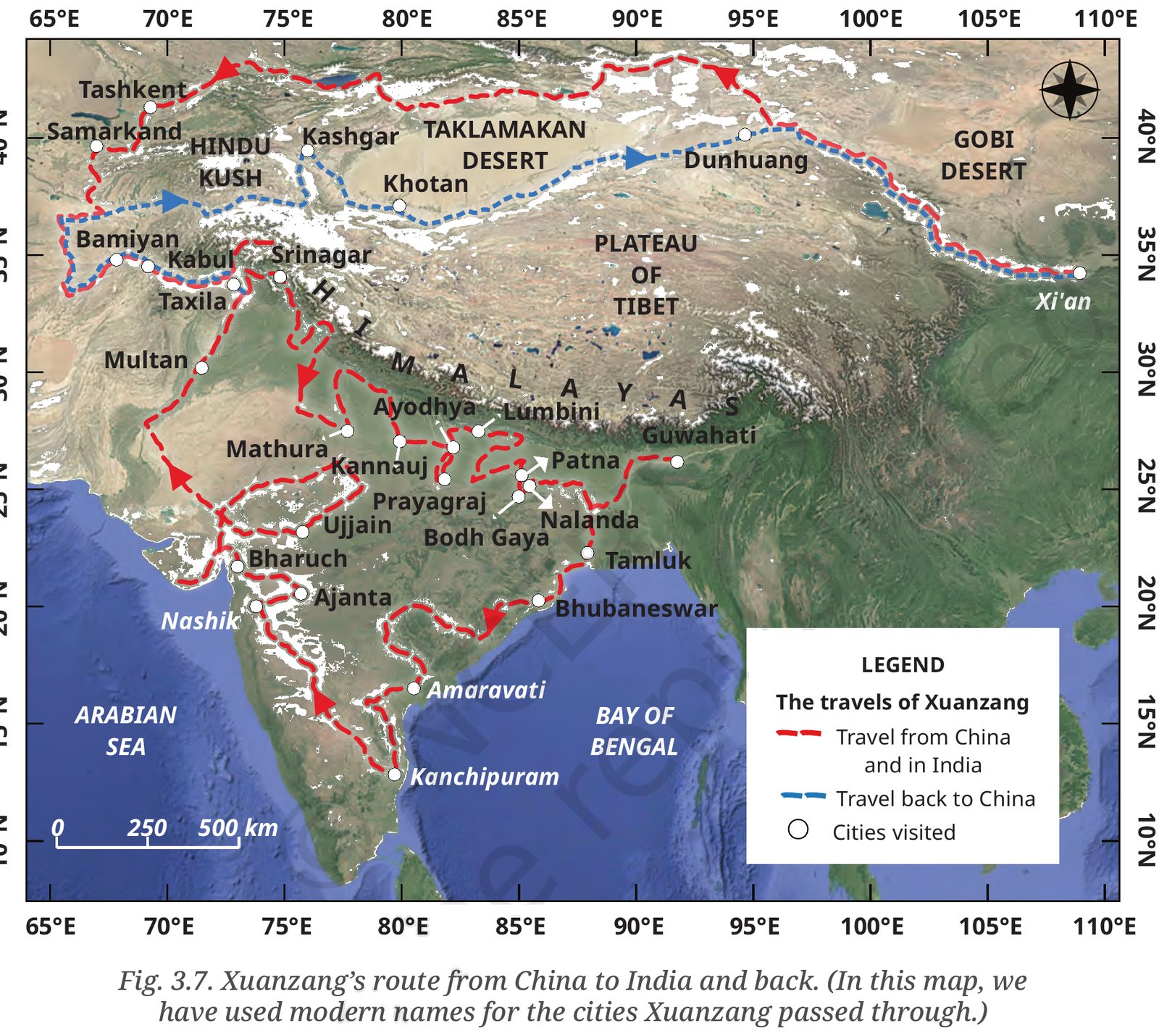
Let's Explore. Looking at the map, can you identify a few mountain passes or desert areas that Xuanzang had to cross while travelling between China and India? Can you also identify a few important Buddhist centres of learning that Xuanzang visited in India? Do you know something of their significance? Fig. 3.7, NCERT Exploring Society: India and Beyond Class 7 Part 2, Chapter 3.
Concept used. A travelogue map plots a journey using labelled terrain features (mountains, deserts) and labelled stopping points (cities). Reading such a map means tracing the dashed route line and reading off every named feature and city it passes through or near.
Trace the outward route (solid red dashes) from Xi'an westward: it skirts the Taklamakan Desert and passes through the Hindu Kush mountains near Bamiyan and Kabul before descending into the Indian subcontinent through Srinagar and Taxila.
Trace the return route (blue dashes): it runs further north, through Khotan and past Dunhuang on the edge of the Gobi Desert, a different, more northerly path than the outward journey.
Identify the major Buddhist centres marked on the map: Taxila, Nalanda and Bodh Gaya are all shown as cities visited.
Recall their significance from the wider chapter: Nalanda was one of the great monastic universities of the period (like Vikramashila, mentioned later in the chapter), and Bodh Gaya is the place where the Buddha is believed to have attained enlightenment, making it the most sacred pilgrimage site for Buddhists.
Xuanzang crossed the Hindu Kush mountains and skirted the Taklamakan and Gobi deserts on his outward and return journeys. In India he visited Buddhist centres such as Taxila, Nalanda (a major monastic university) and Bodh Gaya (the Buddha's place of enlightenment).
AK
Ayesha Khan
M.A. History, Aligarh Muslim University
Verified Expert
Quick reading. A travel map like this rewards reading the legend box first, always, before tracing a single line.
Read the legend: solid red for the outward leg, dashed blue for the return leg, open circles for `cities visited'. This tells you immediately that Xuanzang did not retrace his own steps.
Terrain crossed: Hindu Kush (outward, near Bamiyan/Kabul), Taklamakan Desert (outward, skirted near Kashgar/Khotan), Gobi Desert (return, near Dunhuang).
Buddhist centres and their weight in history: Taxila was already an old centre of learning by Xuanzang's time; Nalanda, where he reportedly studied for years, became the model for later monastic universities such as Vikramashila; Bodh Gaya remains the single most sacred Buddhist pilgrimage site in the world today.
Why this matters. Xuanzang's own written account of this journey is one of the main sources historians use to reconstruct 7th-century India, precisely because he named and described real places we can still locate on a modern map.
Terrain: Hindu Kush, Taklamakan Desert, Gobi Desert. Centres: Taxila, Nalanda, Bodh Gaya, each significant to Buddhist learning or pilgrimage.
Q 3.4
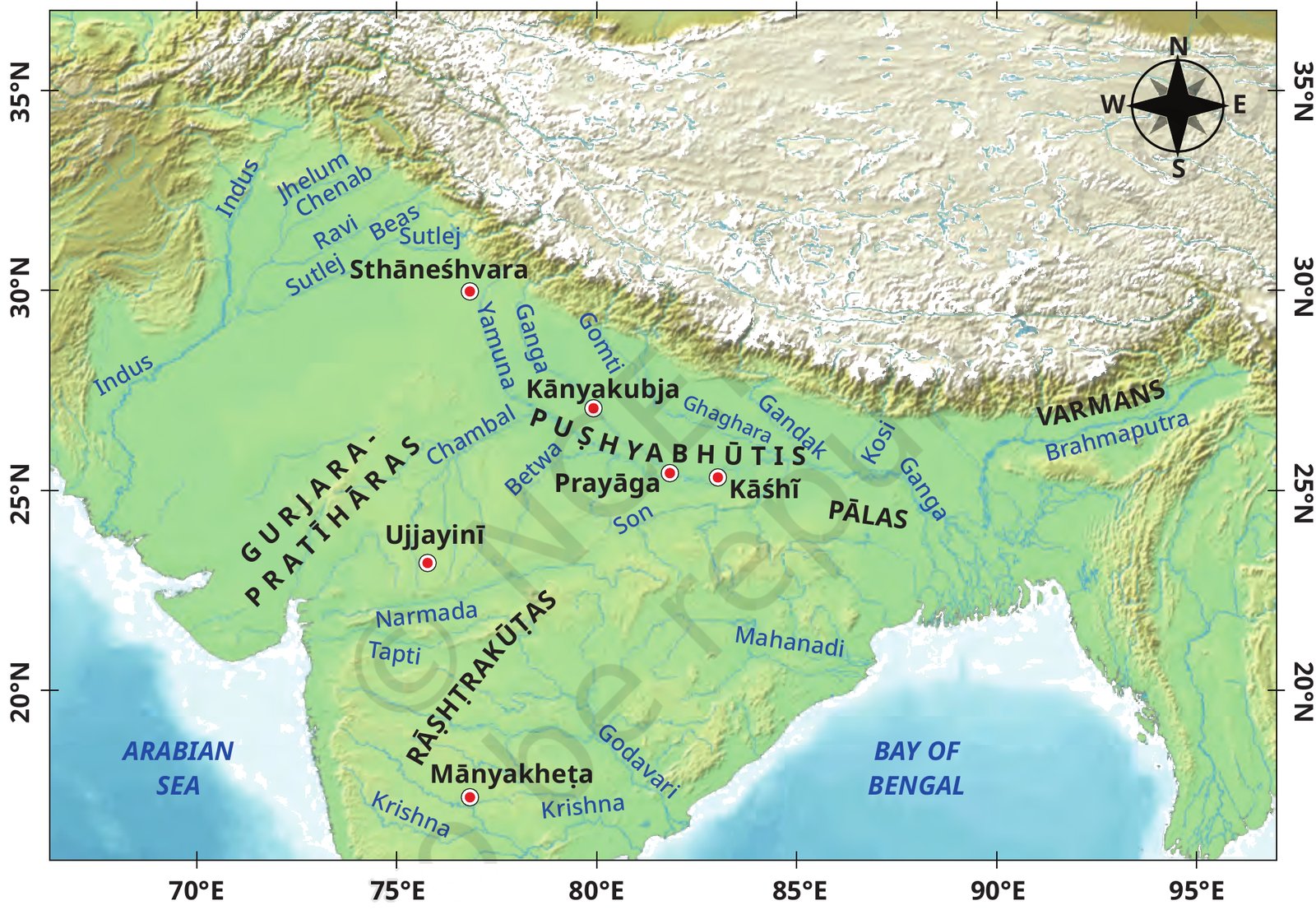
Let's Explore. Why was Kannauj so attractive to those powerful dynasties? Observe its location on the map and discuss in class. Fig. 3.3, NCERT Exploring Society: India and Beyond Class 7 Part 2, Chapter 3.
Concept used. In political geography, a city becomes strategically valuable when it sits where major transport routes, fertile farmland and rival territories all meet. Controlling such a city gives a ruler both economic wealth and a military advantage over neighbours.
Locate Kannauj (Kanyakubja) on the map: it sits on the Ganga, roughly midway between the Gurjara-Pratihara territories to the west and the Pala territories to the east, with the Rashtrakuta Deccan reachable from the south.
Note the river advantage: the Ganga at this point gave Kannauj easy river transport for trade goods and armies, and the surrounding doab (land between the Ganga and Yamuna) was highly fertile, supporting a large population and tax base.
Note the symbolic advantage: the map shows Kannauj had already been the seat of Harshavardhana, the most powerful north Indian ruler of the early 7th century, so holding Kannauj also meant inheriting his prestige as `Kannauj's ruler'.
Put the pieces together: any dynasty that controlled Kannauj controlled a wealthy, well-connected, and symbolically important city that also blocked its two other rivals from expanding further into the Gangetic plains.
Kannauj was attractive because it combined fertile Ganga-Yamuna doab farmland, river-borne trade routes, a central position between the Palas, Gurjara-Pratiharas and Rashtrakutas, and the inherited prestige of having been Harshavardhana's own capital.
KS
Kabir Sinha
M.A. Political Science, Delhi University
Verified Expert
Strategic angle. I find it useful to think of Kannauj the way modern geopolitics thinks of a strait or a border crossing: whoever holds the chokepoint controls the flow of everything through it.
Economic chokepoint: Kannauj sat on the main Ganga trade corridor, so holding it meant taxing goods moving between the west (Gurjara-Pratihara lands), the east (Bengal, under the Palas) and the Deccan (reachable by the Rashtrakutas).
Military chokepoint: because the Vindhya range separates the Deccan from the Gangetic plains, whichever power held Kannauj also effectively decided how far a Deccan power like the Rashtrakutas could push into the north.
Legitimacy chokepoint: possessing the former seat of a `great king of kings' like Harsha let a ruler claim continuity with a respected past, which mattered enormously for a new dynasty's legitimacy.
Why this matters. The two-century Tripartite Struggle over one city, rather than over a whole region, shows students that pre-modern wars were often fought for specific strategic points, not simply for open territory.
Kannauj combined river-trade wealth, a central military position between three rival powers, and the inherited legitimacy of Harsha's old capital, making it worth fighting over for two centuries.
Q 3.5
Let's Explore. Form groups in your class to discuss the following: (a) What qualities does Kalhana think a historian should have? (b) What do these lines reveal about his method of gathering information, and how does it resemble or differ from the way history is currently written? (c) Kalhana writes that a historian's words must `remain free from love or hatred in relating the facts of the past'. What does he mean by this, and how would meeting this condition make a historian more reliable?
Concept used. A primary source's reliability depends partly on the method its author describes using. Kalhana, the 12th-century author of the Rajatarangini (`River of Kings'), tells us directly how he worked, which lets us judge his account as a historian would judge any source: by checking its method, not just believing its conclusions.
Identify the qualities Kalhana names: impartiality (`free from love or hatred'), thoroughness (he says he examined eleven earlier works), and a willingness to cross-check sources (he consulted inscriptions on temple grants and royal records alongside written chronicles).
Explain his method: Kalhana combined multiple written chronicles with inscriptional evidence, exactly the two source types this chapter uses throughout (inscriptions, coins and travelogues). This resembles how historians work today, using several independent sources to check one another.
Explain the difference from modern history-writing: Kalhana openly states a moral purpose, to draw ethical lessons for rulers, which a modern academic historian would usually try to keep separate from the factual narrative itself.
Explain `free from love or hatred': it means not favouring a ruler because you like him, and not blackening a ruler because you dislike him. A historian's personal feelings about a king should not change what facts get included or how they are described.
Explain why this makes a historian more reliable: a reader can trust an account more when they know the author was not writing to flatter a patron or settle a grudge, since that removes one common source of bias in court chronicles.
Kalhana valued impartiality, thoroughness and cross-checking of sources. His method (combining chronicles with inscriptions) resembles modern practice, though his openly moral purpose differs from it. `Free from love or hatred' means judging rulers by evidence rather than personal feeling, which makes an account more trustworthy.
MI
Meera Iyer
Ph.D Sanskrit Studies, University of Hyderabad
Verified Expert
Structural observation. I like to read Kalhana's own words as a historian's job description written nine centuries before the modern discipline existed.
Kalhana names three working habits: reading widely (eleven earlier works), verifying against physical evidence (inscriptions on temple consecrations and land grants), and writing with restraint rather than flattery.
His method resembles modern historical practice in its use of multiple, independent evidence types; it differs in openly stating a didactic aim, since he wants readers to draw moral lessons, something a modern historian usually leaves to the reader.
`Free from love or hatred' is really a warning against writing history to please a current ruler or attack a past enemy; Kalhana links this directly to reliability, arguing that a judge-like, evidence-first attitude is what makes a chronicle worth trusting centuries later.
Why this matters. Historians still use exactly this test today: when reading any chronicle, from any period, the first question is always whether the author had a reason to favour or attack the people they wrote about.
Kalhana prized impartiality, wide reading and cross-checked evidence. His method anticipates modern source-criticism, though his openly moral aim sets it apart; writing `free from love or hatred' means letting evidence, not personal loyalty, shape the account.
Q 3.6
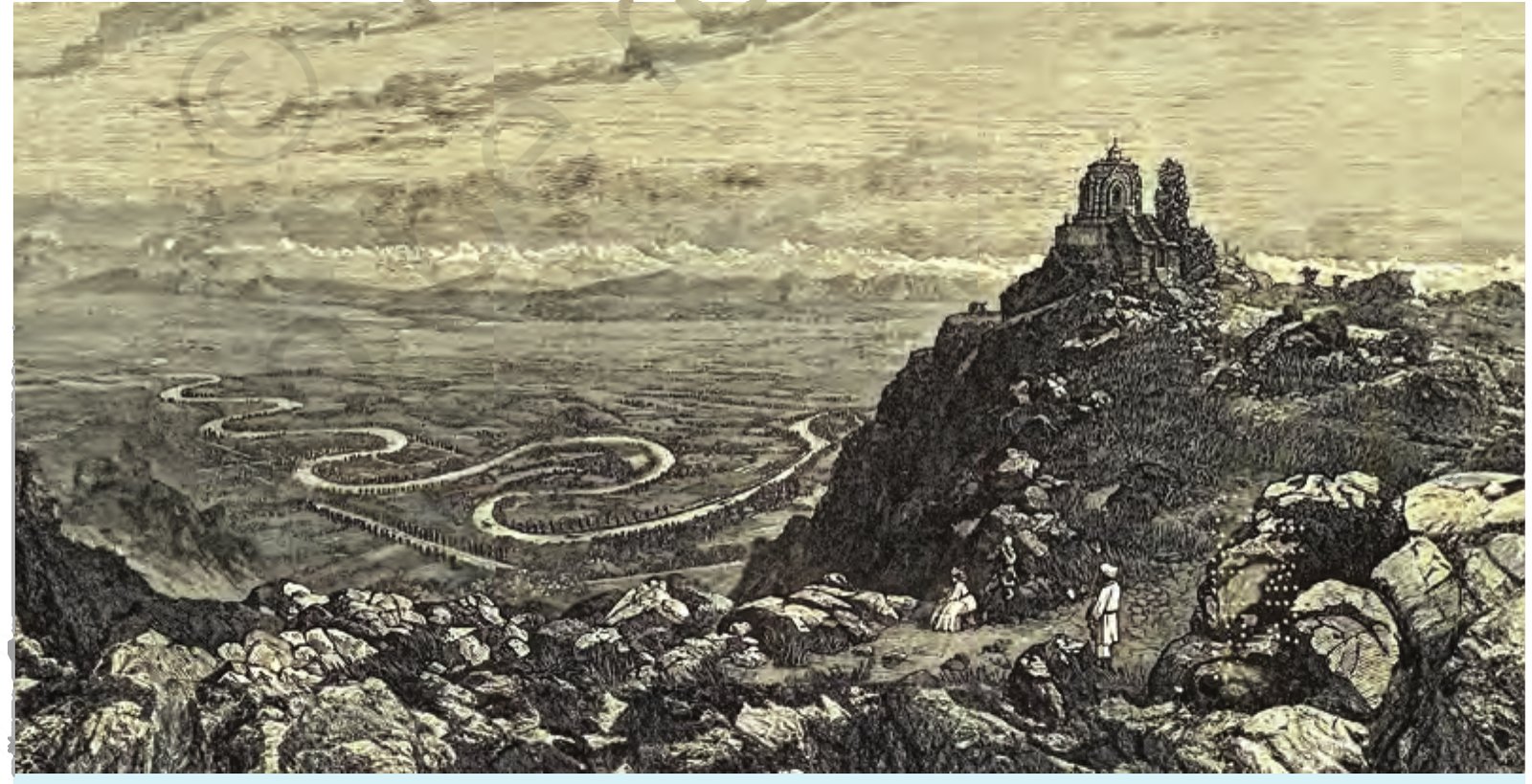
Let's Explore. According to tradition, Adi Shankaracharya, the 8th-century scholar and teacher of the advaita vedanta school of philosophy, visited the hill shown in this sketch, where the stone temple at the top is known as Shankaracharya temple. He established four mathas (monasteries and centres of learning) at Badrinath, Puri, Dwarka and Sringeri. Mark the location of these cities on a map; why do you think he chose four different corners of India rather than more central locations? Fig. 3.14, NCERT Exploring Society: India and Beyond Class 7 Part 2, Chapter 3.
Concept used. A network of institutions placed at the geographic extremes of a region, rather than clustered in one place, is designed for maximum reach. This is a deliberate strategy for spreading an idea or an organisation across the largest possible area.
Locate the four mathas: Badrinath in the Himalayas (north, in present-day Uttarakhand), Puri on the Bay of Bengal coast (east, in present-day Odisha), Dwarka on the Arabian Sea coast (west, in present-day Gujarat), and Sringeri in the Deccan hills (south, in present-day Karnataka).
Notice the pattern: these four sites sit close to the northern, eastern, western and southern extremities of the Indian subcontinent, not near each other.
Reason out the purpose: a teacher who wants a philosophy to spread across the whole subcontinent, rather than stay confined to one region, needs institutions that pilgrims and students from every region can reach without travelling to a single distant centre.
Connect this to the chapter's wider theme: like the monastic universities of Nalanda and Vikramashila described elsewhere in the chapter, these mathas functioned as long-lasting centres of learning that outlived any single ruler's patronage, because they were tied to sacred geography rather than to one dynasty's court.
Shankaracharya placed his four mathas at Badrinath (north), Puri (east), Dwarka (west) and Sringeri (south), the four extremities of the subcontinent, so that advaita vedanta could take root in every major region rather than remain centred in one place.
AN
Arjun Nair
M.A. Ancient History, University of Kerala
Verified Expert
Picture-first. Picture the map as a diamond: Badrinath at the top, Puri at the right point, Dwarka at the left point, Sringeri at the bottom. That diamond shape covers the whole subcontinent.
Plot the four points on a blank outline map of India: Badrinath (Himalayan north), Puri (eastern coast), Dwarka (western coast), Sringeri (southern Deccan).
Observe that no two mathas are close together; each anchors a different linguistic and cultural zone of India (roughly Himalayan/Hindi-speaking north, Odia-speaking east, Gujarati-speaking west, Kannada-speaking south).
Reason about strategy: placing centres of learning at the far edges, rather than clustering them near each other, meant local scholars and pilgrims everywhere could reach one without an enormous journey, spreading the same philosophical tradition consistently across very different regions.
Why this matters. This deliberate `four corners' strategy is one reason advaita vedanta remained a pan-Indian school of thought for over a thousand years, rather than fading into a purely regional tradition.
The four mathas at Badrinath, Puri, Dwarka and Sringeri mark the subcontinent's north, east, west and south, a placement chosen to spread advaita vedanta across every major region rather than keep it centred in one place.
Q 3.7
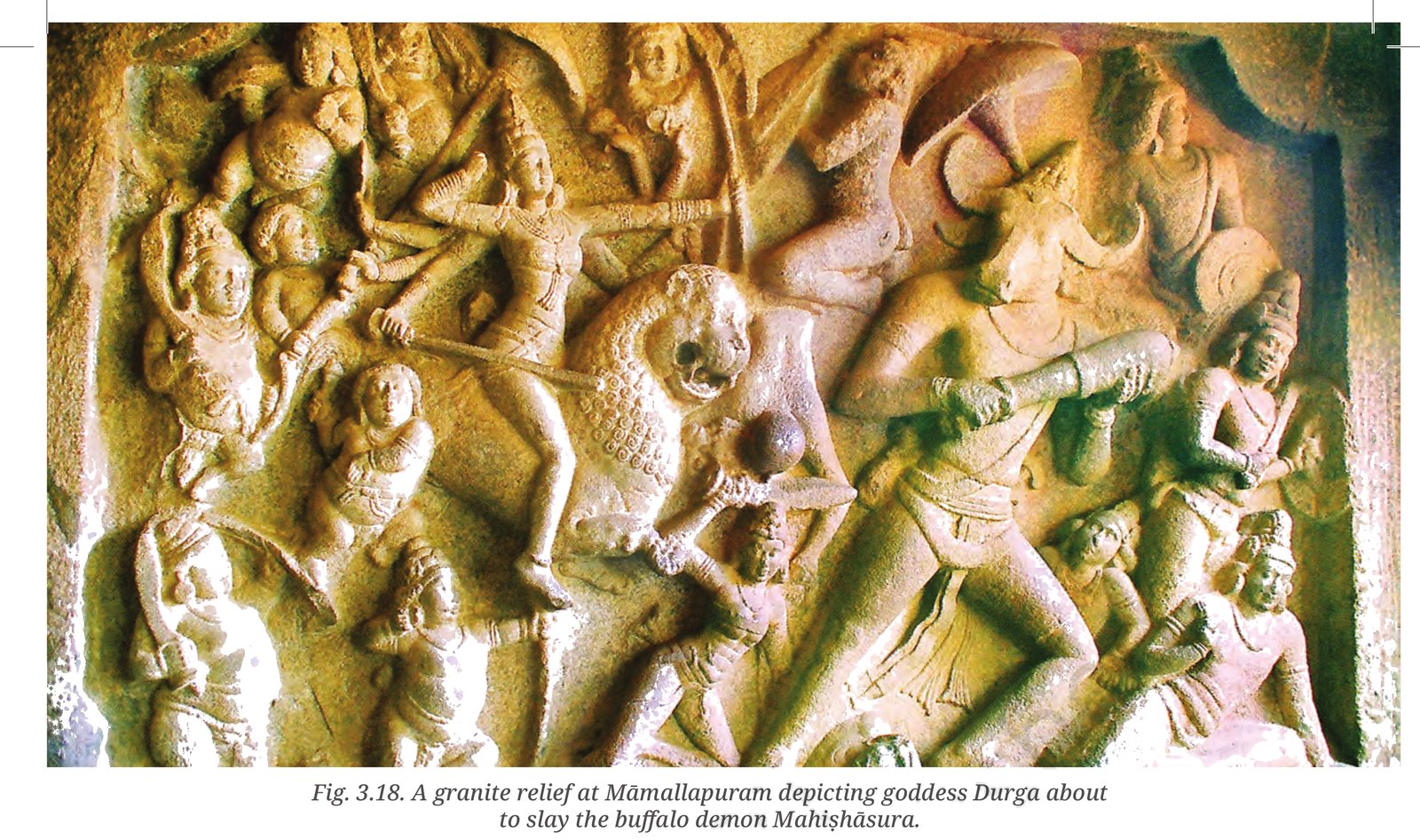
Let's Explore. Note this panel's highly dynamic three-dimensional composition, expressing Durga's confident assault on the demon. Can you identify some of Durga's many weapons? And her vahana? What are the main differences between her attendants and the demon's attendants? What does the demon's slanted posture and general attitude indicate? Fig. 3.18, NCERT Exploring Society: India and Beyond Class 7 Part 2, Chapter 3.
Concept used. In Hindu iconography, a deity's weapons, mount (vahana) and attendants are not decoration; they are visual signals that tell a viewer who the figure is and what qualities they represent. Reading a relief panel means identifying each of these elements in turn.
Identify Durga's vahana: she rides a lion, shown mid-charge beneath her, a mount that signals royal power, courage and ferocity in battle.
Identify her weapons: in this multi-armed depiction she wields several weapons at once, among them a sword and a bow, the traditional arsenal of the warrior-goddess in her Mahishasuramardini (`slayer of the buffalo-demon') form.
Compare the two sides' attendants: Durga is accompanied by disciplined female warriors and small dwarf-like ganas moving with her in coordinated attack, while Mahishasura's attendants are shown in disarray, some already fleeing or falling.
Read the demon's posture: Mahishasura's body leans backward and off-balance, with his club lowered, a posture that signals retreat and defeat rather than confident combat, contrasted sharply with Durga's forward, mounted, attacking stance.
Durga rides a lion and wields multiple weapons including a sword and bow. Her attendants advance in ordered formation while the demon's attendants are shown scattering; the demon's slanted, off-balance posture signals his defeat is already underway.
FS
Fatima Sheikh
M.A. Islamic History, Jamia Millia Islamia
Verified Expert
Picture-first. I always tell students to scan a battle relief the way a film director blocks a scene: who is moving forward, who is moving back, and where the viewer's eye is pulled first.
The eye is pulled first to Durga on her lion, positioned centrally and moving forward, the clear visual `hero' of the composition.
Her weapons (sword, bow, and others held in her multiple arms) show she is equipped for every kind of combat, close and at range, at once.
Her attendants mirror her forward energy, while the demon's followers mirror his own collapse, retreating or already fallen, a compositional trick that tells the story's outcome before you even notice Mahishasura's slanted, losing stance.
Why this matters. This 7th-8th century Pallava relief is one of the finest early depictions of the Mahishasuramardini legend in Indian art, and its sense of motion influenced how the goddess was sculpted in temples across south India for centuries afterward.
Lion vahana; multiple weapons including sword and bow; Durga's attendants advance in formation while the demon's scatter; his backward-leaning, unbalanced posture signals his imminent defeat.
Q 3.8
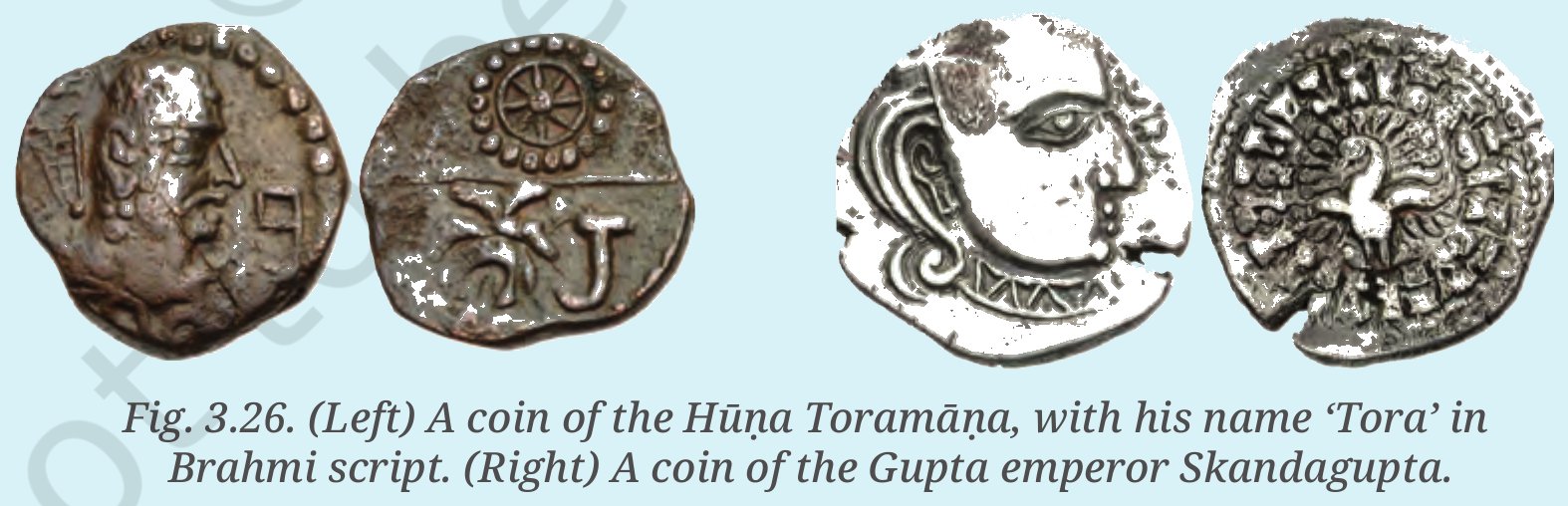
Let's Explore. What details do you observe in these coins? Why do the coins of Toramana and Skandagupta appear so similar? What conclusions can you draw? Fig. 3.26, NCERT Exploring Society: India and Beyond Class 7 Part 2, Chapter 3.
Concept used. Numismatics (the study of coins) treats coin design as a historical source. When two rulers from different dynasties issue coins with near-identical portrait style, script placement and layout, historians read this as evidence of cultural borrowing or a deliberate claim to legitimacy, not coincidence.
Observe the details on Toramana's coin (left pair): a profile portrait bust facing right, with his name `Tora' inscribed in Brahmi script beside the head, and a design on the reverse.
Observe the details on Skandagupta's coin (right pair): a very similarly composed profile portrait bust, also facing right, with a comparable placement of script and a peacock motif on the reverse.
Compare the two: the pose, the bust style and the overall layout are strikingly alike even though Toramana was a Huna leader and Skandagupta was a Gupta emperor from a different, earlier dynasty.
Explain the similarity: the chapter tells us the Hunas adopted Gupta-style royal titles, coin designs and religious symbols after settling in India. Toramana's coin copies the Gupta portrait-style precisely because doing so let a new, foreign-origin ruler present himself with the same visual authority as the well-established Gupta emperors.
Draw the conclusion: coin imitation here is evidence of cultural assimilation, the Hunas were not simply conquerors who stayed foreign; within a few generations they were minting coins, using titles and worshipping deities in styles borrowed directly from the Indian rulers they had once fought.
Both coins share a similar profile-portrait design because the Hunas deliberately copied Gupta coin style to claim similar royal legitimacy. The resemblance is evidence of how quickly the Hunas assimilated into Indian political and visual culture.
RK
Rohan Kulkarni
M.A. History, Fergusson College Pune
Verified Expert
Strategic angle. I treat old coins the way a modern historian treats currency design today: rulers choose imagery to send a message about power and continuity.
Details: both coins show a right-facing royal profile bust with an identifying inscription placed close to the head, a format that was the Gupta dynasty's signature coin style.
Reason for similarity: the chapter explicitly states the Hunas adopted `Gupta-style royal titles, coin designs, and religious symbols'; Toramana's coin is a direct visual echo of Skandagupta's, issued to make his own rule look as legitimate as a Gupta emperor's.
Conclusion: this is not forgery or accident, it is a conscious political strategy. A newly arrived ruler borrows the visual language of the power he has displaced, so that his own subjects see continuity rather than disruption.
Why this matters. Coins are some of the most reliable evidence historians have for this period, because they survive in large numbers and cannot be rewritten later the way a chronicle can.
The coins look alike because Toramana copied Gupta imperial coin design to claim equal legitimacy; the resemblance shows how completely the Hunas assimilated into Indian political culture within a generation or two.
Q 3.9
Let's Explore. The Chachnama records that when King Dahar was killed, his widowed queen put up a brave resistance, and when the situation became hopeless, she immolated herself along with other ladies. Another queen ordered her treasure to be distributed among the brave soldiers and inspired them to stand against the invaders. What does this suggest about the way the indigenous people responded to invasions? Why do you think the queen chose to give away her treasure? What does this reveal about the role of women in warfare?
Concept used. Chronicles written by the conquering side (the Chachnama is a 13th-century Persian account of the Arab conquest of Sindh) still preserve details about the resistance they defeated, since acknowledging a worthy opponent added to the conquerors' own glory. Reading `against the grain' of such a source can reveal the losing side's actions clearly.
Consider what the resistance shows about indigenous responses: the fighting did not end with King Dahar's death on the battlefield. Queens and soldiers continued to resist rather than surrender immediately, showing organised, determined opposition extended beyond the king's own person.
Consider the treasure distribution: giving away wealth to soldiers at the moment of crisis was a practical act, it rewarded and motivated fighters to keep resisting when the outcome was already uncertain, using the queen's own resources rather than hoarding them.
Consider the wider symbolism: a ruler's treasure represented the kingdom's wealth and her own authority; giving it to soldiers was also a public statement that the fight mattered more than personal wealth or safety.
Consider the role of women in warfare: both queens acted as decision-makers in a military crisis, not passive bystanders, one commanding resistance and resource distribution, the other choosing self-immolation over capture, both exercising agency at the highest political level available to them.
The account suggests indigenous resistance continued past the king's death, driven partly by queens acting as decision-makers. Distributing treasure to soldiers was both a practical reward and a symbolic act of shared sacrifice, showing that royal women held real authority and agency during a military crisis.
PD
Priya Deshmukh
Ph.D Epigraphy, Deccan College Pune
Verified Expert
Quick reading. Whenever a source describes the losing side with respect, as the Chachnama does here, I read that respect itself as a historical clue worth examining.
Resistance did not stop at the king's death: this tells us Sindh's political and military structure had more than one centre of authority, since the queens could still organise a fight.
Treasure distribution served two purposes at once, material reward for continued fighting and a symbolic declaration that the kingdom's wealth was being spent on its defence rather than saved for the victors to seize.
Women's agency: acting to organise resistance, or choosing death over capture, are both recorded here as deliberate, authoritative acts, not incidental details, which tells us women of the ruling class held recognised power during a crisis, even in a source written by the conquering side.
Why this matters. That even a conqueror's own chronicle preserves these details is itself significant: it shows how much the resistance impressed observers on both sides of the conflict.
Continued resistance after the king's death, the queen's treasure distribution to sustain her soldiers, and the recorded agency of royal women together show that authority in a crisis was not confined to the king alone.
Q 3.10
Think About It. Every five years, Harsha held an assembly at Prayaga where, after performing sacred rites, he gave away much of his wealth to Buddhists, Brahmins and the poor. Does this ceremony remind you of a similar event discussed in Part 1 of this textbook?
Concept used. Ritual gift-giving (dana) by a ruler was a recognised way for kings across many dynasties in early India to display wealth, piety and generosity all at once, in front of an audience of subjects, monks and visiting scholars.
Recall Harsha's Prayaga assembly as described in this chapter: held every five years, after sacred rites, distributing wealth to Buddhists, Brahmins and the poor, and reported directly by the visiting pilgrim Xuanzang.
Recall that Part 1 of this textbook describes the Gupta emperors in similar terms, as generous patrons who performed grand rituals and made large religious and charitable donations to display their status as ideal, righteous kings (a model of kingship often called dharmic rule).
Draw the parallel: Harsha's Prayaga ceremony follows the same pattern of a powerful ruler using a public, ritualised act of giving to project an image of legitimacy and piety, connecting his reign visibly to an older tradition of royal generosity.
Explain why rulers repeated this pattern: a public giving ceremony reached far more people than any single military victory could, and it let a king be remembered as generous and pious, not just powerful, which mattered for how later generations and chroniclers judged his reign.
Harsha's five-yearly Prayaga giving-ceremony echoes the pattern of grand ritual generosity associated with earlier north Indian rulers discussed in Part 1 of this textbook, where large-scale royal gift-giving was used to display piety and reinforce legitimacy.
VC
Vikram Chauhan
M.A. History, University of Rajasthan
Verified Expert
Strategic angle. I read royal ceremonies as public performances with a clear political script: ritual first, generosity second, legitimacy as the payoff.
Harsha's ceremony has three visible parts: sacred rites (religious legitimacy), wealth distribution (economic generosity), and a repeated five-year cycle (so the message reaches a new audience regularly, not just once).
This matches the wider pattern of royal patronage running through this chapter, Dharmapala founding Vikramashila, the Rashtrakutas carving the Kailashanatha temple, kings across dynasties using visible acts of generosity or construction to build reputation.
The parallel with earlier Gupta-era ritual generosity (Part 1 of this textbook) confirms this was a long-running, recognised strategy of kingship in early India, not something Harsha invented.
Why this matters. Recognising this pattern helps a student read any royal ceremony described in a source critically: as image-building as much as genuine charity, though the two were not seen as contradictory at the time.
Harsha's Prayaga assembly repeats a recognisable early-Indian royal pattern also seen in the Gupta era covered in Part 1: ritual plus generosity, used deliberately to build a ruler's public legitimacy.
Q 3.11
Think About It. Some historians state that Dharmapala was Buddhist, and he certainly patronised Buddhist learning and institutions. But in ancient India, the concept of religion was more fluid than it is today, and rulers often took pride in patronising several schools of thought at once. What does this tell us about religious identity and royal patronage in this period?
Concept used. `Religious fluidity' means that people, including kings, could honour and support more than one belief system at the same time, without treating them as mutually exclusive categories the way modern religious labels sometimes imply.
Note the specific claim about Dharmapala: he patronised Buddhist learning heavily (founding Vikramashila), which is why some historians call him Buddhist, yet the chapter is careful to say this label may be too simple.
Recall the chapter's other examples of the same pattern: Harsha supported Buddhism while also being described as a devotee of Shiva; several later Pala rulers, though still patronising Buddhist institutions, were said to be devotees of Shiva too; the Rashtrakutas patronised Hindu, Buddhist and Jain schools of thought equally.
Explain why this pattern existed: Hindu, Buddhist and Jain traditions in this period shared central concepts such as dharma and karma, and sometimes shared sacred spaces and artistic motifs, so patronising more than one was not seen as contradictory.
Draw the wider conclusion: a king's religious patronage in this period reflected political and cultural strategy as much as personal belief, supporting multiple traditions broadened a ruler's base of support across different religious communities within the kingdom.
Royal religious patronage in this period was rarely exclusive. Rulers such as Dharmapala, Harsha and the Rashtrakutas supported multiple traditions at once, reflecting a fluid religious landscape where Hindu, Buddhist and Jain practice often coexisted rather than competed.
AB
Ananya Bose
M.A. History, Presidency University Kolkata
Verified Expert
Structural observation. I treat `religion' in this period as a spectrum of patronage choices, not a fixed personal identity the way it is often treated today.
Dharmapala's Buddhist patronage (Vikramashila) is real and significant, but the chapter's language (`some historians state') signals this label is a simplification, not a certainty.
Across the chapter, the same pattern repeats with Harsha, later Pala rulers and the Rashtrakutas: heavy patronage of one tradition alongside genuine support for others.
This tells us religious categories in early medieval India functioned differently from today; traditions shared vocabulary, sacred spaces and even some deities, so a ruler's support for multiple schools reflected the culture's own fluid boundaries, not personal indecision.
Why this matters. Understanding this fluidity prevents students from projecting today's sharper religious categories backward onto a period when they simply did not apply in the same way.
Dharmapala's case, like Harsha's and the Rashtrakutas', shows that royal religious patronage in this period was often plural and strategic, reflecting a genuinely fluid religious landscape rather than one fixed personal faith.
Q 3.12
Think About It. Al-Masudi, a 10th-century Arab historian and traveller from Baghdad, gave high praise to a Rashtrakuta ruler: `His troops and elephants are innumerable... There is none among the rulers of Sindh and Hind who in his territory respects the Muslims [as he does]. In his kingdom, Islam is honoured and protected... mosques and congregational mosques, which are always full, have been built for offering prayers five times.' What does this tell us about the Rashtrakutas?
Concept used. A foreign traveller's eyewitness account is valuable evidence precisely because the observer has no reason to flatter a ruler out of local loyalty. When such a source praises a specific, checkable detail, like the existence of working mosques, it strengthens the account's reliability.
Identify what Al-Masudi actually reports: a large, well-resourced military (troops and elephants), and, more specifically, functioning mosques that were `always full', built for Muslim traders and residents within a Hindu-ruled kingdom.
Connect this to the wider chapter theme of religious pluralism: like Dharmapala, Harsha and other rulers discussed elsewhere in this chapter, the Rashtrakutas extended patronage and protection beyond their own preferred traditions.
Connect this to the trade context: the chapter elsewhere describes Arab, Christian, Persian and Jewish traders active on India's coasts during this period; a Rashtrakuta ruler protecting Muslim worship fits directly with maintaining good relations with the Arab merchant communities his kingdom's trade depended on.
Draw the conclusion: this account tells us the Rashtrakutas were militarily powerful and also religiously tolerant as a matter of policy, protecting a minority faith's places of worship, likely both from genuine pluralist values and from practical interest in encouraging trade.
Al-Masudi's account shows the Rashtrakutas as a militarily strong dynasty that also protected Muslim worship and traders within their Hindu-ruled kingdom, reflecting both a genuinely pluralist approach to religion and a practical interest in maintaining valuable Arab trade links.
SR
Siddharth Rao
M.A. Archaeology, MS University Baroda
Verified Expert
Quick reading. I read foreign travelogues by first asking: what does this observer have to gain by exaggerating, and does that match what else we know?
Al-Masudi has no reason to overstate a Hindu ruler's generosity toward Islam, which makes this praise unusually credible as evidence.
Cross-reference with the chapter's broader pattern: the Rashtrakutas are described elsewhere as patronising `Hindu, Buddhist, and Jain schools of thought' equally, so extending real protection to Islamic worship as well fits their documented general policy of religious tolerance.
Cross-reference with the chapter's trade section: India's west coast saw brisk shipping with Arab-controlled ports from the 8th century onward, so protecting Muslim merchants and their places of worship was also sound economic policy for a dynasty that benefited from that trade.
Why this matters. This account is a rare case of an outsider's direct testimony matching a ruling dynasty's broader, independently documented pattern of behaviour, which is exactly the kind of cross-confirmation historians look for.
Al-Masudi's testimony confirms the Rashtrakutas combined real military strength with a genuine, policy-level tolerance of Islam, consistent with their wider reputation for patronising multiple religious traditions and with their economic stake in Arab trade.
Q 3.13
Don't Miss Out. During this period, inscriptions began using both Sanskrit and regional languages simultaneously. In land grants, the ruler and his dynastic history were often praised in Sanskrit, while the operative details of the grant were recorded in the local language. Why do you think such inscriptions were written in two languages?
Concept used. An inscription can have more than one intended audience. When a document is written in two languages, each language is usually chosen to reach a different kind of reader or to serve a different purpose within the same text.
Identify the two audiences: Sanskrit was the learned, pan-Indian language of court poetry, religious ritual and dynastic prestige, understood by priests, scholars and the ruling elite across regions.
Identify the local-language audience: the regional language was understood by the local officials, witnesses and villagers who actually had to carry out and respect the terms of the land grant, most of whom would not read formal Sanskrit.
Connect language choice to content: the Sanskrit portion (praising the ruler and his ancestry) was about legitimacy and prestige, a performance for an elite and divine audience, while the local-language portion (the operative grant details, boundaries, beneficiaries) was a practical, legally binding record for local use.
Draw the general conclusion: bilingual inscriptions let a single document do two jobs at once, project royal grandeur in the prestige language while remaining genuinely usable and enforceable at the local level in the language people actually spoke.
Sanskrit carried the ruler's prestige and dynastic legitimacy for an elite, pan-Indian audience, while the regional language recorded the grant's practical details for local officials and villagers, so the same inscription could serve both a symbolic and a functional purpose.
LP
Lavanya Pillai
M.A. Tamil Literature, University of Madras
Verified Expert
Quick reading. I always ask who actually needs to understand each part of a document, and that usually explains a shift in language halfway through.
The Sanskrit eulogy section answers the question `who is granting this, and why is he legitimate?', aimed at readers who valued classical learning and dynastic genealogy.
The local-language section answers the question `what exactly is being granted, to whom, and where are its boundaries?', aimed at readers who had to act on the grant directly.
This split reflects the wider bilingual and multilingual culture of the period described in this chapter, Sanskrit and Tamil literature flourishing together under the Pallavas and Cholas, or Sanskrit and Kannada under the Rashtrakutas, each language doing the job it was best suited for.
Why this matters. Bilingual inscriptions are valuable evidence today precisely because they let historians cross-check the same event from two linguistic traditions, and they show how ordinary regional life connected to a much wider, Sanskrit-literate elite culture.
The dual-language format let one inscription serve two purposes: Sanskrit projected royal prestige to an elite, pan-Indian audience, and the regional language made the grant's practical terms understandable and enforceable for local people.
Q 3.14
Think About It. The Kayasthas, historically known as scribes or clerks, were initially a professional group open to different varnas. In the 10th century, they became a distinct jati, with certain Brahmana surnames later associated with Kayasthas, indicating a fusion of Brahmana and non-Brahmana families who then married mainly within their group. How does a professional group transform into a jati?
Concept used. A jati is a hereditary social group, historically often linked to occupation, into which people are born and within which they typically marry. An occupation-based group becomes a jati when membership stops being based only on the job someone does and starts being passed down through birth and marriage instead.
Start with the open profession: scribes and clerks (the future Kayasthas) originally could come from different varnas, anyone with the right skill and training could do this work.
Identify the turning point: over time (by the 10th century for the Kayasthas), families in this profession increasingly married within the same occupational circle rather than across it.
Identify the fusion step: the chapter's example shows Brahmana families (with surnames like Vasu, Ghosha, Datta, Dama) merging through marriage with non-Brahmana scribal families, creating one new, blended community.
Identify the outcome: once marriage happened mainly within this group across generations, the profession-based community hardened into a jati, membership was now inherited by birth, not simply chosen by taking up the job.
A professional group becomes a jati when its members, over generations, begin marrying mainly within their own occupational circle rather than across it. This turns open, skill-based membership into a hereditary, birth-based identity, as happened with the Kayasthas by the 10th century.
NV
Nikhil Verma
M.A. History, Allahabad University
Verified Expert
Structural observation. I treat jati-formation like a slow-motion version of how any close-knit professional community can turn into something more permanent, given enough generations.
Stage one: an open occupational category (`people who do scribal work'), recruited on skill, not birth.
Stage two: increasing social closeness within that occupational circle, shown here by intermarriage between Brahmana and non-Brahmana scribal families.
Stage three: once endogamy (marrying within the group) becomes the norm across generations, the group's boundary hardens into something inherited, a jati, rather than something chosen by taking up a trade.
Why this matters. This process explains why India's varna-jati system, though it looks rigid from the outside, was historically capable of absorbing new occupational and even regional groups over time, exactly the flexibility the chapter highlights elsewhere.
Intermarriage within an occupational circle, sustained across generations, is what converts an open profession into a closed, hereditary jati, as the Kayastha case from the 10th century demonstrates.
Q 3.15
Think About It. Sulaiman, a 9th-century Arab merchant and traveller, wrote of a Gurjara-Pratihara ruler: `This king maintains numerous forces, and no other Indian prince has so fine a cavalry. He is unfriendly to the Arabs... there is no greater foe of the Muhammadan faith than he... There is no country in India safer from robbers.' Why do you think the author calls the ruler a `foe to the Muslim faith'?
Concept used. A foreign traveller's account reflects their own political and religious interests as much as the facts they observed. Sulaiman was writing from the perspective of Arab trading and expansionist interests, so a ruler who successfully resisted those interests would naturally be described in hostile religious terms.
Recall the context from earlier in the chapter: the Gurjara-Pratiharas, under rulers like Nagabhata I, actively and successfully resisted Arab military advances into Rajputana and Malwa after the conquest of Sindh.
Identify what `foe to the Muhammadan faith' actually describes: not religious persecution of Muslims within his kingdom, but military and political opposition to further Arab conquest, the very thing Sulaiman, as an Arab traveller, would resent most.
Note the contrast within the same quote: Sulaiman also praises this ruler's strong cavalry, good administration and safety from robbers, admiring qualities that sit oddly next to `foe of the faith', showing the hostility is specifically about resisting Arab expansion, not about how Muslims were treated locally.
Draw the conclusion: Sulaiman's phrase reflects an Arab merchant's frustration at a ruler who successfully blocked Arab territorial and religious expansion, described in the language of religious rivalry because Arab military expansion of this period was itself framed in religious terms.
Sulaiman calls the ruler a `foe of the Muslim faith' because the Gurjara-Pratiharas successfully resisted Arab military expansion into India, a resistance that, from an Arab traveller's viewpoint, looked like religious hostility rather than ordinary political and military defence.
TJ
Tanvi Joshi
Ph.D Medieval Indian History, SNDT University
Verified Expert
Strategic angle. I read hostile labels in travel accounts as evidence of successful resistance, not evidence of religious persecution, unless the source says otherwise.
The chapter already tells us the Gurjara-Pratiharas repeatedly defeated Arab advances after the conquest of Sindh, so Sulaiman is describing a ruler who was genuinely effective at stopping Arab military expansion.
Sulaiman's own praise of the ruler's cavalry, administration and internal safety confirms this is a respectful, even admiring account, the `foe of the faith' label sits alongside compliments, not accusations of cruelty toward Muslims.
This matches the wider pattern the chapter describes elsewhere: Arab dominion in India stayed limited to a couple of small states in Sindh and Punjab for three centuries, precisely because rulers like this one kept blocking further advance.
Why this matters. This quote shows how easily political and military conflict gets described using religious labels, a pattern worth watching for in any historical source, ancient or modern.
The label reflects the ruler's success at halting Arab military expansion, described by an Arab observer in religious terms because Arab expansion of the period was itself framed as a religious mission.
Q 3.16
Think About It. The table lists common everyday words, highlighting their similar pronunciation across Sanskrit, Arabic and English. Complete the table:
tabular@p3.6cmp3.6cmp3.6cm@
Sanskrit & Arabic & English
(blank) & sandal & sandalwood
tambula & tanbul & (blank)
karpura & (blank) & camphor
pippali & filfil & (blank)
tabular
Concept used. Many everyday trade-good words travelled from Sanskrit into Arabic (via land and sea trade routes) and from there into European languages including English, keeping a similar sound at each step. Filling the blanks means working out which English or Arabic word has a sound close enough to its Sanskrit root to be its known cognate.
Row 1 (given: sandal / sandalwood): the missing Sanskrit word is candana, the Sanskrit name for sandalwood; Arabic sandal and English sandalwood both trace back to it through Middle Persian.
Row 2 (tambula / tanbul / blank): the Sanskrit word for the betel leaf, tambula, gave Arabic tanbul; the missing English word is betel, the name for the same leaf used for chewing paan.
Row 3 (karpura / blank / camphor): the missing Arabic word is kafur, which Sanskrit karpura gave rise to, and which in turn passed into English as `camphor'.
Row 4 (pippali / filfil / blank): the missing English word is pepper, since Sanskrit pippali (`long pepper') passed through Persian and Arabic filfil into Greek peperi and Latin piper, the direct ancestor of English `pepper'.
Quick reading. I solve tables like this by treating each row as a mini chain of sound-changes across three languages, and reading the given cells as anchors for the missing ones.
Sandalwood row: Sanskrit candana to Middle Persian čandal to Arabic sandal to English `sandalwood', each step keeping the `s/c-n-d' sound skeleton recognisable.
Betel row: Sanskrit tambula to Arabic/Persian tanbul; English `betel' actually arrived via a different, Malayalam-derived route (vettila through Portuguese), but the classroom table pairs it here as the recognised English name for the same tambula leaf.
Camphor row: Sanskrit karpura is itself close to a Malay source word; Arabic kafur sits between Sanskrit and English `camphor', which arrived via Old French camphore.
Pepper row: Sanskrit pippali (`long pepper') to Persian pilpil to Arabic filfil to Greek/Latin piper, the direct root of English `pepper'.
Why this matters. This table is a compact lesson in how far Indian Ocean trade networks reached: words for spices moved between Sanskrit, Arabic, Persian, Greek, Latin and English, tracing the same routes the goods themselves travelled.
Missing words: candana (Sanskrit for sandal), betel (English for tambula/tanbul), kafur (Arabic for karpura/camphor), pepper (English for pippali/filfil).
Q 3.17
Think About It. We have met some 12 dynasties in this chapter. During the same period, many more existed in India: the Bhanjas, Chapas, Guhilas, Kalachuris, Kadambas, Maitrakas, Maukharis, Saindhavas, Shilaharas, Somavamshis, Tomaras, Utpalas, Paramaras, Chahamanas and Gangas, most of them with several branches. What does this longer list tell you about the depth and richness of India's regional history in this period?
Concept used. A textbook chapter can only cover a limited number of dynasties in detail, chosen because their sources are richer or their territorial reach was wider. A much longer list of names that a chapter deliberately sets aside tells a reader something important about the true scale of the history involved.
Count the scale: the chapter names roughly 12 dynasties it discusses in some depth, then lists 15 more it does not, meaning at least 27 distinct ruling houses existed across India in just this one period.
Recognise what this implies about regional history: political power in early medieval India was extremely fragmented and locally rooted, with many small kingdoms controlling limited territories alongside the larger empires this chapter focuses on.
Recognise what this implies about sources: dynasties that receive detailed textbook coverage (like the Rashtrakutas or the Cholas) usually have more surviving inscriptions, coins or literary references; smaller dynasties may be historically significant locally but are harder to document in a short chapter.
Connect this to the chapter's larger argument: the closing sections of the chapter describe this period as one of `dynamic integration' and regional consolidation rather than empty chaos, and this long, uncovered list of dynasty names is direct evidence of just how many centres of political and cultural life existed simultaneously.
The long, mostly uncovered list shows that early medieval India held far more political complexity than a single chapter can capture, dozens of regional kingdoms coexisted alongside the empires studied in depth, each with its own local history worth further study.
DK
Divya Krishnan
M.A. History, Madras Christian College
Verified Expert
Structural observation. I treat a `see also, but we won't cover these' list as a deliberate signal from the textbook about the limits of any single narrative.
The sheer number, at least 27 named dynasties for one roughly four-century period, tells us early medieval India's political map looked more like a patchwork of many regional powers than a story of two or three big empires.
Coverage choices in a textbook reflect available evidence and territorial reach, not the lived importance of a dynasty to the people who actually lived under it; a small, well-documented branch dynasty mattered enormously to its own region.
This matters for how a student should read any history textbook: depth of coverage is always a filter applied by the historian or textbook writer, and a longer, uncovered list is an honest signal of everything that filter has left out.
Why this matters. Recognising this kind of gap is itself a historical skill: it teaches a student to ask `what is this account choosing not to tell me, and why?' whenever they read any historical narrative.
This list of at least 15 additional dynasties, alongside the 12 covered in depth, shows early medieval India's political landscape was far richer and more fragmented than any single chapter can fully capture.
Questions and Activities
Q 3.18
If you lived in Kannauj during the struggle between the Palas, the Pratiharas and the Rashtrakutas, how would it change your daily life and your estimate of the rulers? Write a letter on this to your friend living in Kanchipuram.
Concept used. An empathetic historical letter uses real facts from the chapter (who was fighting, why, and what ordinary life was like) but expresses them through an imagined personal voice. Good marks come from accuracy woven into the imaginative form, not from imagination alone.
Set the factual scene: Kannauj in the 8th-9th centuries was fought over repeatedly by three powers, the Palas from the east, the Gurjara-Pratiharas from the west, and the Rashtrakutas from the Deccan, with `fluctuating outcomes and no lasting victor', as the chapter states.
Describe daily-life effects: repeated changes of ruler would mean uncertainty about taxation, disrupted trade along the Ganga, and the constant risk of the city itself becoming a battleground, since no single power held it securely for long.
Describe how your `estimate of the rulers' might shift: a resident might grow skeptical of any ruler's promises of lasting peace, since the city had already changed hands multiple times, while also noting that most kings, whichever dynasty, still needed the city's trade and administration to function and so had some interest in its stability.
Contrast with Kanchipuram, your friend's city: Kanchipuram under the Pallavas (and later the Cholas) was a major cultural and trade hub further from the main zone of conflict, so the letter can draw a contrast between Kannauj's instability and the comparatively steadier life further south.
Close the letter with a personal reflection that ties the historical facts to a believable emotional response, curiosity, wariness, or hope for stability, grounded in what the chapter actually tells us about the period.
A strong answer is written as a genuine letter, naming the three warring powers correctly, describing real effects of repeated conquest (disrupted trade, uncertain taxation, insecurity), and contrasting this with a calmer picture of Kanchipuram, all supported by facts drawn directly from the chapter.
AB
Aditya Bhattacharya
M.A. History, Presidency University Kolkata
Verified Expert
Picture-first. I picture a Kannauj resident as someone living through a decades-long tug-of-war, not one dramatic battle, and I write the letter around that slow, grinding uncertainty.
Open the letter describing a specific, small daily detail, a market closed because of troop movements, or news of `yet another' new governor, to make the instability feel real rather than abstract.
Weave in the actual three powers and the real length of the struggle (spanning the 8th and 9th centuries), so the imaginative letter stays historically anchored, and name at least one concrete effect, disrupted river trade, an uncertain harvest tax, or a garrison suddenly quartered in the neighbourhood.
Add a line about your changing `estimate of the rulers': perhaps you once trusted whichever king held the city, but repeated changes of ruler have taught you to judge a king by how he treats ordinary residents, not by which dynasty's banner currently flies over Kannauj.
End by asking your friend in Kanchipuram what life is like there, inviting a comparison that shows you understand Kannauj's situation was not universal across India, the south had its own, different politics under the Pallavas and Cholas.
Why this matters. Writing history as a personal letter forces a student to translate abstract political events (`a tripartite struggle') into lived consequences, which is exactly the skill historians use when writing social history, and it also builds empathy for people who lived through political instability without any say in it.
An effective letter grounds the Tripartite Struggle's real facts (three named powers, decades of contested control, disrupted city life) in a believable personal voice, tracks how repeated conquest reshaped the writer's trust in rulers, and contrasts Kannauj's instability with Kanchipuram's comparatively different situation.
Q 3.19
Emperors and kings during this period controlled only core regions and governed other regions through subordinate vassals. What would be the advantages and the challenges of such a system?
Concept used. A vassal or samanta system is a form of indirect rule: a central ruler controls a core territory directly, while more distant regions are governed by local subordinate rulers who owe loyalty, tribute or military service to the centre, as this chapter describes for the Chalukyas and Rashtrakutas.
List the advantages: a central ruler could control a much larger territory than direct administration alone would allow, since local samantas already understood their own region's people, geography and customs, reducing the cost and difficulty of distant governance.
List a second advantage: samantas led their own armies and managed local administration, as the chapter notes, which meant the central ruler gained additional military strength without having to raise and pay for it all directly.
List the challenges: the chapter states samanta loyalty `could be fragile, especially when they felt that the empire's central authority was weakening', meaning the system was only as strong as the central ruler's ongoing power and prestige.
Use the chapter's own example of the risk: the Rashtrakutas themselves began as samantas under the Chalukyas before growing powerful enough to overthrow their overlords, showing that a vassal system always carries the risk of a subordinate becoming a rival.
Advantages: wider reach, local expertise, and extra military strength at lower direct cost. Challenges: vassal loyalty depended on the central ruler staying strong, and an ambitious samanta could, as the Rashtrakutas did to the Chalukyas, eventually overthrow the very power he served.
SR
Sneha Reddy
M.A. History, Osmania University
Verified Expert
Strategic angle. I think of a vassal system the way a modern organisation might think of franchising: wider reach and lower direct cost, but weaker central control over each branch.
Advantage one: administrative reach without administrative cost, samantas managed provinces (bhuktis or rashtras), districts (mandalas) and villages using their own local officials, saving the central court from having to build that entire structure itself.
Advantage two: built-in military reserves, since samantas `led armies', a central ruler effectively commanded a much larger combined force than his own standing army alone.
Challenge: the entire system rested on personal loyalty and perceived strength rather than fixed institutions, so any sign of central weakness invited samantas to act independently, or worse, to turn against their overlord, exactly as the Rashtrakutas did to the Chalukyas.
Why this matters. This tension, between the efficiency of indirect rule and the risk of losing control over it, recurs throughout Indian history well beyond this chapter, making it one of the most useful concepts for understanding pre-modern empires generally.
The samanta system traded direct central control for wider reach and extra military strength, at the constant risk that a locally powerful vassal, once the centre weakened, could break away or seize power outright, as the Rashtrakutas' own rise shows.
Q 3.20
In what ways were the invasions of the Hunas and the Arabs different in their aims, methods and impact on the Indian subcontinent? Prepare a write-up, discuss and present it in class.
Concept used. Comparing two historical invasions means examining each along the same set of dimensions, aims (what the invaders wanted), methods (how they fought and organised), and impact (what changed afterward), so the comparison is structured rather than a simple list of differences.
Compare aims: the Hunas were a nomadic people pushing into the Ganga plains seeking territory and plunder, without a clear religious or ideological mission; the Arabs, by contrast, combined territorial conquest with an explicitly religious framing, as bin Qasim's own words about `religious war' in the chapter show.
Compare methods: the Hunas relied on horse-riding, archery and `lightning-fast attacks' as a mobile steppe power; the Arabs used organised naval raids first (on Thana, Bharukachchha, Debal) followed by a land campaign under a formal military command structure sent by the governor of Iraq.
Compare immediate impact: the Hunas were decisively defeated by the Aulikara dynasty in the early 6th century and never established lasting rule in India; the Arabs did secure lasting, though limited, territorial control in Sindh and Punjab after 712 CE, holding those two regions for centuries.
Compare long-term impact: the chapter tells us the Hunas fully assimilated into Indian society within a few generations, adopting Sanskrit, Gupta-style titles and Hindu symbols; the Arab conquest of Sindh, by contrast, had a `limited political and religious impact' compared to Arab conquests elsewhere, with Hindus and Buddhists allowed to continue their worship, but it also opened the door, described in the next chapter, to further incursions from the northwest.
The Hunas were a mobile, plunder-seeking steppe people who were defeated and fully assimilated within a few generations. The Arabs combined naval and land campaigns with a religious framing, secured limited but lasting territorial control in Sindh and Punjab, and had a more restrained but longer-lasting political impact.
MT
Manav Trivedi
M.A. Public Administration, University of Lucknow
Verified Expert
Strategic angle. I compare invasions the way I would compare two different business strategies entering the same market, what did each want, how did each operate, and did either succeed long-term?
Aims: the Hunas wanted plunder and territory as steppe conquerors with no stated ideological programme; the Arabs combined conquest with a religious mission, explicit in Muhammad bin Qasim's own recorded words.
Methods: the Hunas fought as fast-moving cavalry raiders; the Arabs used a staged approach, naval raids first, then a formal land invasion under a named military commander answering to a regional governor.
Outcomes: the Hunas were repeatedly defeated (most decisively by the Aulikaras) and absorbed into Indian society within generations, visible even in their Gupta-style coinage; the Arabs held onto Sindh and Punjab for three centuries despite repeated resistance, though their `Arab dominion in India was limited to just two petty states', a genuinely different, longer-lasting but geographically narrow outcome.
Why this matters. Comparing these two invasions on the same dimensions shows students that `foreign invasion' is not one single kind of event, its aims, methods and consequences can differ enormously even within the same chapter's timeframe.
Hunas: plunder-driven, cavalry-based, defeated and fully assimilated. Arabs: conquest with religious framing, staged naval-then-land campaign, limited but genuinely lasting territorial control in Sindh and Punjab.
Q 3.21
Imagine you are a common citizen watching the Prayaga assembly. How would you react to Harsha giving away most of his wealth?
Concept used. An imaginative role-play answer should stay anchored to the specific facts the chapter gives about the event (who attended, what was given, how often it happened) while adding a believable personal reaction consistent with the social position you have chosen to imagine.
Recall the facts to build the scene: every five years at Prayaga, after performing sacred rites, Harsha gave away much of his wealth to Buddhists, Brahmins and the poor, an event witnessed and recorded by the pilgrim Xuanzang.
Choose and justify a social position: a common citizen might be a poor villager who could directly benefit from the distribution, or a trader who benefits indirectly from the crowds and activity the assembly draws to Prayaga.
Describe a plausible reaction: awe at the scale of the giving, gratitude if directly benefiting, and perhaps genuine respect for a ruler willing to part with royal wealth in public, since this was a rare, visible act rather than a private one.
Add a thoughtful complication: a more skeptical citizen might also wonder how Harsha's treasury was replenished before the next assembly, since taxes and revenues from ordinary people ultimately supported this generosity.
A well-grounded answer imagines a believable citizen (poor recipient, trader or skeptical observer) reacting with a mix of awe, gratitude and, optionally, thoughtful questioning about where the wealth being given away had originally come from, all tied to the chapter's actual description of the five-yearly Prayaga assembly.
IB
Ishita Bansal
M.A. History, Lady Shri Ram College
Verified Expert
Picture-first. I picture the assembly through the eyes of someone standing at the very back of a huge crowd, straining to see the king but clearly feeling the scale of the event.
Ground the scene in real detail: thousands gathered at Prayaga, at the sacred confluence of the Ganga and Yamuna, every five years, an event large enough that a foreign pilgrim like Xuanzang travelled to witness it.
Build the emotional reaction in layers: initial astonishment at the sheer visible wealth being distributed, followed by personal hope of receiving something, followed by a more reflective sense of what such generosity says about a ruler's character and priorities.
Round out the answer with balance: acknowledge that such spectacles also served the king's own reputation and legitimacy, so a citizen's admiration could coexist with an awareness that the ceremony was, in part, a performance of ideal kingship.
Why this matters. Writing history from an ordinary person's imagined viewpoint is a skill historians call `history from below', it reminds us that grand political events were experienced very differently by the people living through them than by the rulers who staged them.
A citizen at Prayaga would likely feel genuine awe and gratitude at witnessing Harsha's public generosity, while a more reflective observer might also recognise the ceremony as a deliberate, recurring display of royal legitimacy.
Q 3.22
Forming groups, let each group choose one Alvar and one Nayanar and prepare a biography poster or booklet. Include their life stories and a sample poem or two (in translation).
Concept used. The Alvars (12 Vishnu devotees) and Nayanars (63 Shiva devotees) were Tamil bhakti poet-saints whose devotional poetry, composed from around the 6th century CE onward, shaped the wider pan-Indian Bhakti Movement described in this chapter. A biography poster should cover who the saint was, what they are known for, and a sample of their actual poetry.
Choose one Alvar: Andal, the only woman among the 12 Alvars, remembered for her intense devotional poetry addressed to Vishnu, later compiled in the Tiruppavai, still recited in Vishnu temples across Tamil Nadu today.
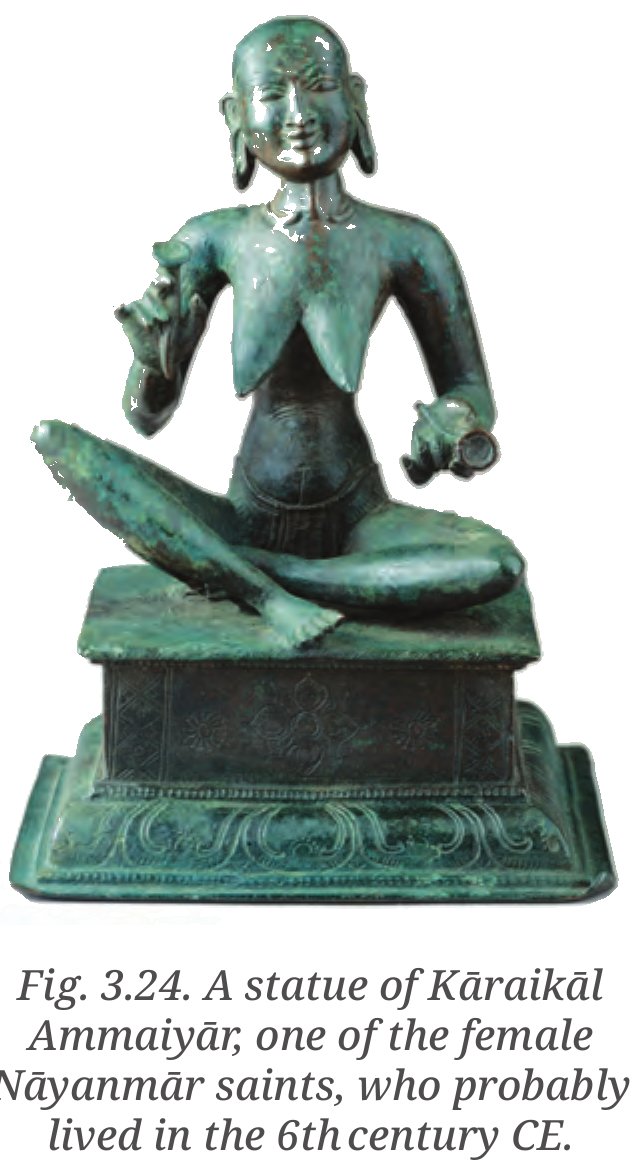
Choose one Nayanar: Karaikkal Ammaiyar, one of only three women among the 63 Nayanars, who probably lived in the 6th century CE and is remembered for extreme ascetic devotion to Shiva. Fig. 3.24, NCERT Exploring Society: India and Beyond Class 7 Part 2, Chapter 3.
Structure the poster: a short life story for each (background, the moment or reason for their devotion, how they are remembered), a sample poem or verse in English translation for each, and an image or symbol associated with them (Andal is often shown with a garland; Karaikkal Ammaiyar is depicted, as in Fig. 3.24, in an emaciated ascetic form holding cymbals).
Add historical context linking both figures to the chapter: both belonged to the wave of Tamil bhakti poetry from the 6th century onward that `cut across gender and social divisions', a detail this chapter highlights explicitly, and both figures are proof of that claim in a single, concrete example.
A strong poster names a specific Alvar (such as Andal) and a specific Nayanar (such as Karaikkal Ammaiyar), gives a short accurate life sketch of each, includes a translated sample verse, and connects both to the chapter's point that the Bhakti Movement opened devotional leadership to women and people from many social backgrounds.
KS
Karthik Subramaniam
M.A. Tamil History, Madurai Kamaraj University
Verified Expert
Picture-first. I design a poster the way a museum exhibit label works, a striking image, a two-line hook about the person, then the fuller story beneath.
For Andal: hook line, `The only woman among the twelve Alvars, who saw herself as Vishnu's own bride'; body text covering her devotional intensity and the Tiruppavai's continuing use in temple ritual today.
For Karaikkal Ammaiyar: hook line, `A Nayanar who chose fierce asceticism over worldly beauty, out of devotion to Shiva'; body text covering her transformation story and her enduring image as a gaunt, cymbal-playing devotee.
Close the poster with a shared theme box: both saints, though devoted to different gods, represent how the Bhakti Movement gave women a recognised, celebrated place in a spiritual tradition at a time when formal religious authority was usually reserved for men.
Why this matters. Andal and Karaikkal Ammaiyar are still actively remembered and worshipped today, showing how a chapter on 6th-10th century history connects directly to living religious practice in modern India.
A well-built poster pairs a specific Alvar (Andal) and Nayanar (Karaikkal Ammaiyar), each with an accurate life story, a translated verse, and a closing note on how both exemplify the Bhakti Movement's opening of devotional leadership to women.
Q 3.23
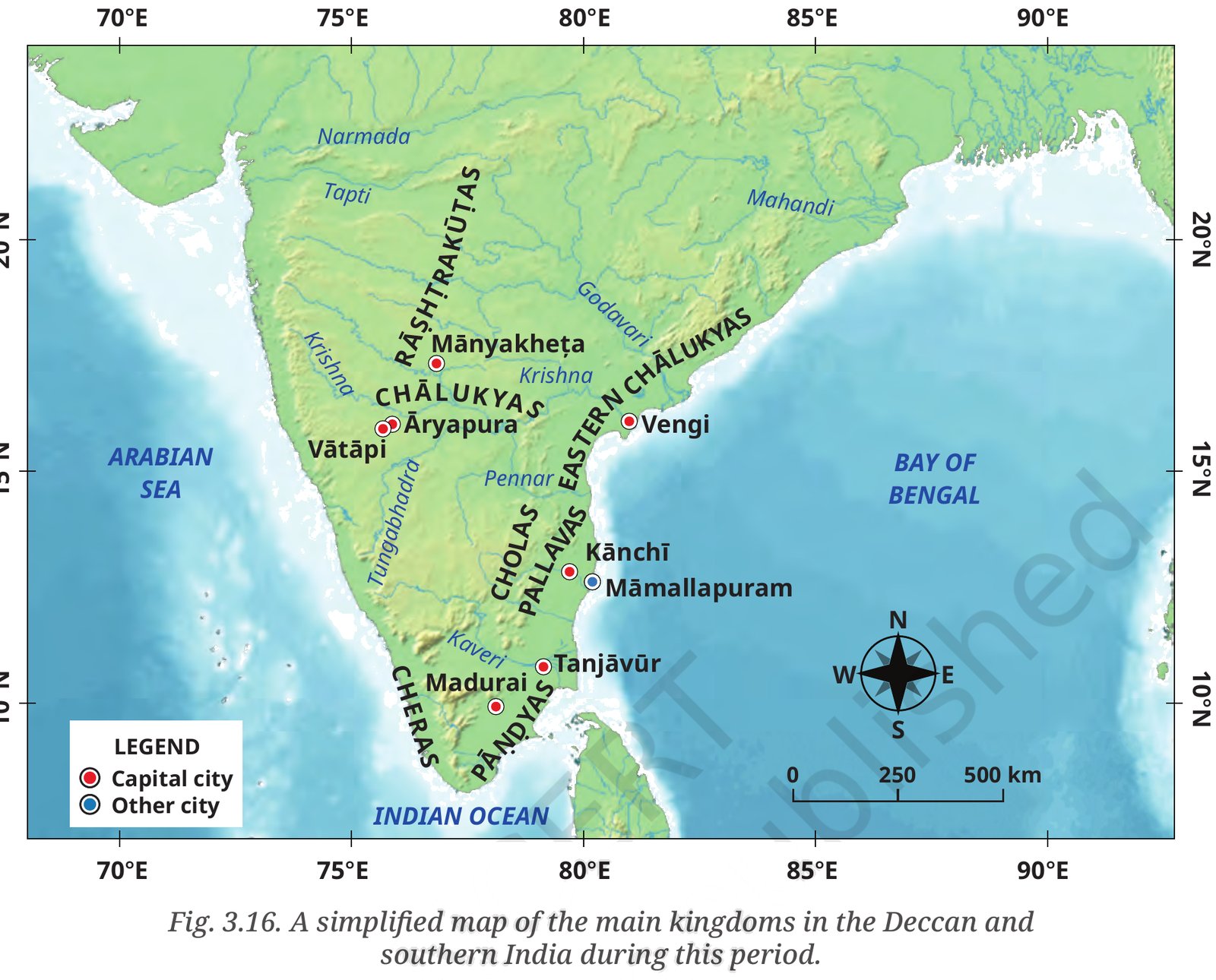
You will notice that our maps show only ancient names for the kingdoms' capitals and main cities. Using a pencil, mark the modern names next to their original names. Refer to the current map of India and try to locate those cities on it. Fig. 3.3, NCERT Exploring Society: India and Beyond Class 7 Part 2, Chapter 3.Fig. 3.16, NCERT Exploring Society: India and Beyond Class 7 Part 2, Chapter 3.
Concept used. Many Indian cities have kept a recognisably similar name across many centuries, while others changed considerably. Matching an ancient map name to its modern equivalent means checking each name against what the city is called today, often the same word in a modernised spelling, sometimes a completely different name.
From the northern map (Fig. 3.3): Sthaneshvara = Thanesar (Haryana); Kanyakubja (Kannauj) = Kannauj (Uttar Pradesh, the name has barely changed); Ujjayini = Ujjain (Madhya Pradesh); Kashi = Varanasi (Uttar Pradesh); Prayaga = Prayagraj, formerly Allahabad (Uttar Pradesh); Manyakheta = Malkhed, near Gulbarga (Karnataka).
From the southern map (Fig. 3.16): Vatapi = Badami (Karnataka); Aryapura = Aihole (Karnataka); Vengi = a site near Eluru (Andhra Pradesh); Kanchi = Kanchipuram (Tamil Nadu); Mamallapuram = Mahabalipuram (Tamil Nadu, both names still in use today); Tanjavur = Thanjavur (Tamil Nadu); Madurai = Madurai (name unchanged).
Mark each pair with a pencil on a photocopy or tracing of the map, writing the modern name in brackets beside the ancient name.
Locate each modern city on a current political map of India to see how the ancient kingdoms' capitals map onto today's states: mostly Uttar Pradesh and Madhya Pradesh in the north, and Karnataka, Andhra Pradesh and Tamil Nadu in the south.
Key matches: Kanyakubja (Kannauj), Ujjayini (Ujjain), Sthaneshvara (Thanesar), Vatapi (Badami), Manyakheta (Malkhed), Kanchi (Kanchipuram), Tanjavur (Thanjavur), with Kannauj, Mamallapuram and Madurai keeping nearly the same name today.
RM
Radhika Menon
Ph.D Historical Geography, Jawaharlal Nehru University
Verified Expert
Structural observation. I sort name changes into three types: unchanged, lightly modernised, and completely renamed, which makes a long list like this much easier to memorise.
Unchanged or nearly unchanged: Kannauj, Madurai, Mamallapuram (still used alongside Mahabalipuram), names that have survived largely intact for over a thousand years.
Lightly modernised spelling: Ujjayini to Ujjain, Tanjavur to Thanjavur, Kanchi to Kanchipuram, the underlying name is recognisable but standard modern spelling has smoothed the pronunciation.
Completely renamed: Vatapi to Badami, Manyakheta to Malkhed, Sthaneshvara to Thanesar, Kashi to Varanasi, where the modern name has no obvious phonetic link to the ancient one and must simply be learned.
Why this matters. This exercise trains a skill historians use constantly, cross-referencing old place names against modern gazetteers, since most primary sources from this period use only the names current in their own time.
Sorting the pairs into unchanged (Kannauj, Madurai), lightly modernised (Ujjayini/Ujjain, Tanjavur/Thanjavur, Kanchi/Kanchipuram) and fully renamed (Vatapi/Badami, Manyakheta/Malkhed, Sthaneshvara/Thanesar) makes the full set of matches easy to mark and remember.
Q 3.24
Match the ruler or the dynasty with the city:
tabular@p6cmp6cm@
(a) Rashtrakutas & (i) Kanchi
(b) Gurjara-Pratiharas & (ii) Tanjavur
(c) Cholas & (iii) Manyakheta
(d) Harshavardhana & (iv) Ujjayini
(e) Pallavas & (v) Kanyakubja
tabular
Concept used. A match-the-following on capitals tests recall of which dynasty ruled from which city at the point the chapter emphasises. Some dynasties had more than one capital over time, so the correct match uses the capital the chapter itself associates most closely with that ruler or dynasty.
(a) Rashtrakutas: the chapter states their capital was Manyakheta (modern Malkheda) in present-day Karnataka, after Dantidurga shifted their power centre there \(\Rightarrow\) (iii).
(b) Gurjara-Pratiharas: the chapter states their capital, originally Bhillamala, `seems to have shifted later to Ujjayini' \(\Rightarrow\) (iv).
(c) Cholas: the chapter states Vijayalaya's `new capital at Tanjavur' founded the Chola kingdom's power base \(\Rightarrow\) (ii).
(d) Harshavardhana: the chapter states he ruled `from Kannauj (or Kanauj, anciently known as Kanyakubja)' \(\Rightarrow\) (v).
(e) Pallavas: the chapter states their capital was `at Kanchi (or Kanchipura, present-day Kanchipuram)' \(\Rightarrow\) (i).
(a)-(iii); (b)-(iv); (c)-(ii); (d)-(v); (e)-(i).
YP
Yashwant Pillai
M.A. History, University of Mysore
Verified Expert
Strategic angle. On a match-the-following, I first match the pairs I am completely certain of, then use elimination for the rest, which avoids second-guessing a correct answer.
Certain matches first: Pallavas-Kanchi (i) and Cholas-Tanjavur (ii) are stated plainly and repeatedly across the chapter, match these immediately.
Next-certain: Rashtrakutas-Manyakheta (iii) is also stated directly and is reinforced by the map in Fig. 3.16, where Manyakheta sits clearly inside Rashtrakuta territory.
Remaining two by elimination: with (i), (ii), (iii) used, only Ujjayini (iv) and Kanyakubja (v) remain for the Gurjara-Pratiharas and Harshavardhana; since the chapter explicitly calls Kannauj `anciently known as Kanyakubja' and ties it to Harsha, that leaves Ujjayini for the Gurjara-Pratiharas, matching the chapter's own note about their capital shifting there.
Why this matters. Working from certainty to elimination is a general test-taking strategy that reduces careless errors on any match-the-following question, not just this one.